
Read It Again!
The Power and Necessity of Sharing Our Stories


Hello! Many of you resonated with last week’s post on the importance of spending time in God’s “meta-narrative” as a means of molding our hearts. Thanks for taking the time to email me. I always appreciate your reflections and comments.
Welcome to all the new folks who joined us this week to dig into deep discipleship. Glad you are with us!
If you're new and want to catch up, jump to the first post in this series and then move ahead at your own pace. Below is a short summary of some of what we’ve covered so far.
We’re continuing a conversation about what philosopher and theologian Dallas Willard called “The Great Omission.” He surveyed modern Christianity and concluded that, though we talk a lot about making disciples, we struggle to actually do it.
A disciple is an apprentice of Jesus. It’s someone who centers their lives around becoming more like Him; that we increasingly think, act, relate, and love like He does. This journey is often also called spiritual formation or character formation.
Like our bodies, our hearts are powered by an “operating system.” There are forces at work in our hearts that we usually don’t think about, such as ideas and desires. Ideas are assumptions and conclusions that govern how we think and act; desires are our true passions and longings. Ideally, even these unconscious parts of ourselves are molded more like Jesus so that we love as He loves without even thinking about it.
However, exploring these ideas and desires is a journey many people don’t or won’t take. It requires becoming people of depth, intentionally and increasingly attuned to God, others, and ourselves. Crisis, suffering, and conflict are common invitations into this world of depth.
We experience The Great Omission individually and corporately. We may sense a quiet, consistent disconnection from God, others, and ourselves. We may wonder, “Is this all there is to a life with Jesus? Where is this “abundant life”? On a larger scale, a lack of deep discipleship results in a lack of seeking each other’s goodness, resulting in social and cultural harm.
This condition is compounded by Three Primary Problems: the Discipleship Dilemma (which we dove into last year), the Formation Gap, and the Forgotten Kingdom (which we’ll discuss later).
Any intentional effort to be formed more like someone else is best accomplished in specific environments that embody five key elements: time, habit, community, intimacy, and instruction. If we don’t have access to intentional ecosystems that embrace all five elements, we may find ourselves in the Formation Gap.
Modern Christianity generally functions from the idea that instruction is the chief (or only) formative element. The reduction of the other four elements results from several hundred years of Western enlightenment philosophy and thinking, which have reduced our understanding of what it means to be human. We aren’t brains on sticks.
Perhaps one of the most important questions for anyone apprenticing with Jesus (or thinking about it) is this: How is one person formed more like another? Or, to put it another way, how are our base ideas and desires formed to be more like those of Jesus? The answer is complex and beautiful and more relational and experiential than we might assume.
We are exploring time as a necessary element in our spiritual formation. Time intentionally spent with like-hearted people who have our backs is essential, as is time spent soaking in God’s meta-narrative—that He graciously created us and put us on this earth to steward and redeem it with Him. He was, is, and will dwell with those who desire Him because of His passionate desire for us.
The Neverending Story
While it’s vital that we immerse ourselves in the experience of God’s story and His delight, desire, and passion for us as He dwells with us, there is another facet here worth exploring: the story of you. Your story isn’t separate from the story God is writing, of course, though it is unique.
I’m no scientist (I majored in classical piano, of all things), but I’m fascinated by the intersection of theology and neuroscience/neurobiology. In recent years, some brilliant people have explored recent advances in PTSD treatment, various cognitive and restorative therapies, and studies of how the brain operates in light of our understanding of God and faith.
This type of holistic approach to the human person is not always popular. Post-Enlightenment, science is supposedly the new and only source of truth. If we can’t validate it, it must not exist. And, at least according to some, science and religion don’t belong in the same room (or the same mind).
Additionally, some who follow Jesus don’t tolerate the idea that God can be found and experienced outside of the Bible and traditional Christian practices.
Years ago, I worked in a faith-based healthcare organization, and a Christian nurse was offended that I used data and analytics to draw conclusions about patient care.
“We only need prayer. God will tell us how best to care for people.”
I replied, “Ma’am, I’m not sure why God wouldn’t speak through data. If we believe that the earth is the Lord’s and all it contains, He might communicate using modern technology in addition to His still small voice.”
The conversation didn’t end well.
However, if we hold to the meta-narrative we outlined last week, God is in the business of inviting us to experience Him in a myriad of ways. Since He created and is redeeming the cosmos, we can likely find Him in neuroscience, business, or the arts.
Back to the Dilemma
If you’ve been reading Soil & Roots for a while, you may recall our discussions regarding the Discipleship Dilemma last year. The quest to know God more intimately also requires us to know ourselves. Our discipleship depends on increased self-awareness. This type of self-knowledge is not simply about facts. It is the quest to understand why we think, act, relate, and love how we do. And the answer to “why” is often found in our backstories.
This self-exploration is rarely permitted, taught, or modeled in modern Christianity, thus the dilemma. Many are stuck in their spiritual formation because they feel shame, guilt, or selfishness at the prospect of digging into their hearts, though that is where Jesus often meets us.
This concept of “double knowledge” has been accepted and embraced for centuries (until recently), and modern neuroscience appears to be validating (unsurprisingly) this theological position.
A crucial element in greater self-knowledge is the truthful retelling of our stories.
Curt Thompson, a psychiatrist and author, writes:
As our minds develop, eventually we try to make sense of our lives. We take the input from our awareness of our conscious, vertical, horizontal and memory domains, and begin to tell our stories, with most of that content being nonverbal and nonconscious in nature. This narrative is highly influenced by our most intimate attachment relationships.
Elsewhere, he notes, "We can only change what we bring into awareness, and our stories—especially the ones we’d rather forget—hold the key to transformation."
Our stories, particularly our painful moments, matter. Neglecting, ignoring, repressing, or “just moving on” from our past struggles without authentically relaying them is to deny ourselves healing and transformation—necessary steps forward in our discipleship.
However, it’s not that we tell our stories once. Or twice. It’s that we take the time to share our stories over and again in healthy environments with a few people who are adept at listening.
This shouldn’t surprise us since God shares His story (most notably in both His books) and desires that we experience it repeatedly. We are reminded of the power of story every time we finish reading our young children a book and they insist we read it again. And again. And again.
PSTD treatment pioneer Bessel Van der Kolk notes, "As long as a memory is inaccessible, the mind is unable to change it. But as soon as a story starts being told, particularly if it is told repeatedly, it changes—the act of telling itself changes the tale."
How does our story change simply by repeating it?
A Slow Saunter Towards Truthfulness
Repeated storytelling, in the right circumstances, allows the brain to slowly and surely come to grips with what is actually true. The heart’s acceptance of truth leads to freedom and peace.
Let’s take betrayal, for example. The victim of personal betrayal will often quickly conclude that they are entirely at fault for the action. They will assume they deserve to be betrayed. Who wouldn’t? To conclude otherwise means the betrayer has ulterior and sinister motives, which causes the victim to question not one person but two. The heart can only handle so much.
But in most cases, the victim of betrayal is just that - the victim. And the heart’s journey from taking unhealthy responsibility to accepting the damaging role of the betrayer is often long, painful, and filled with ups and downs.
It’s one thing for the mind to conclude the betrayer may be partially or fully at fault. It’s another for the heart to catch up.
Many times, repeatedly telling the story is the best way for the heart to eventually give up its responsibility for the betrayal and place it where it belongs. The story changes, becoming more authentic and accurate as it is retold and responded to by compassionate listeners.
Back to Dr. Van der Kolk:
Finding words where words were absent before and, as a result, being able to share your deepest pain and deepest feelings with another human being... This is one of the most profound experiences we can have, and such resonance, in which hitherto unspoken words can be discovered, uttered, and received, is fundamental to healing the isolation of trauma—especially if other people in our lives have ignored or silenced us. Communicating fully is the opposite of being traumatized.
Van der Kolk teaches that expressing and processing traumatic memories through storytelling can actually rewire neural pathways, leading to improved mental health and well-being.
Storytelling Essential to Discipleship
Telling and retelling our stories as a means of spiritual formation and healing is accepted in just a few places today, primarily the counseling room and the support group.
This is a travesty considering the obvious role God has designed storytelling to play in the redemptive lives of humans. Over 40% of the Bible is narrative, and God’s story is intricately and marvelously woven through creation and culture. Our fascination and wonder with movies, books, and theater indicate the heart’s resonance with story.
Many of us live in cultures where progress, movement, and achievement are paramount in business and church. We live in the idea that we are constantly moving forward—looking backward is ignored or derided. Again, this is an odd set of assumptions considering the role the Bible plays in the lives of disciples. We embrace and absorb its history to develop greater intimacy with God, others, and ourselves.
I’m a huge fan of the Great Commission, though the instruction to “go” does not preclude or minimize the importance of slowly, gently, and intentionally resting in and exploring our backstories. Though modern culture perpetually tells us to “get over it,” that process of “getting over it” is best accomplished through a safe, secure, deliberate telling and retelling of the moments that have so powerfully formed us into who we are. It’s an essential part of the journey into who we are becoming. And it takes time, both ours and the friends with whom we share.
Duc In Altum!
Brian

The Soil & Roots Podcast
What part does story play in modern Christianity? If it is vital to our spiritual formation, where do we find people and places to explore God’s story and how ours fits into His?
Doc, Handsome Kyle, and I are back in the Greenhouse to explore further my conversation with Zach Leighton (Episode 102). Dr. Boswell uses his usual zinger questions, researched quotes, and heartwarming stories to help us mine the depths of how narrative weaves its way into a disciple's life and how repeating and exploring our stories are often pathways to healing, hope, and a deeper experience in the Kingdom.
Watch or listen here:
Grab the Book!
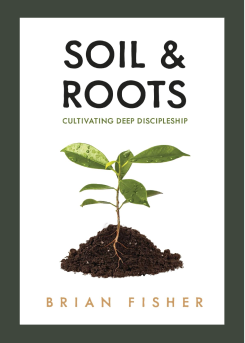
The Soil & Roots book is an excellent primer on deep discipleship and Christian spiritual formation. It is available in softcover and Kindle formats. Please check it out and leave a review!

Why Is There No Option for a Paid Subscription?
I write on behalf of Soil & Roots, a Christian non-profit organization that encourages deep discipleship through its content and supports small formative communities called Greenhouses. Our efforts are funded through donations, and Substack doesn’t provide a donation option. To support Soil & Roots’ writings and work, visit our website and make your monthly, tax-deductible contribution there. Thanks!

Where Else Can I Find You?
Website (lots of info on Greenhouses, plus our blog and podcast library)
Spotify (complete podcast library)
Facebook (great community of folks venturing into deep disciples plus the obligatory memes)
YouTube (complete podcast library, including original audio episodes)
Email me at fish@soilandroots.org or leave a comment on Substack.